More Than 23 Percent of Phoenix Commercial Space is Currently Vacant.
As Greater Phoenix continues to grow, commercial property owners face a changing real estate market. Could renovating and repositioning existing office buildings help attract the next generation of tenants?
Phoenix has long been associated with rapid growth. New residential developments, expanding employment centers, and major corporate investments have transformed the Valley over the past several decades.
But there’s an interesting contradiction in the region’s commercial real estate market.
While Greater Phoenix continues to attract residents and businesses, nearly one-quarter of its office space remains vacant.
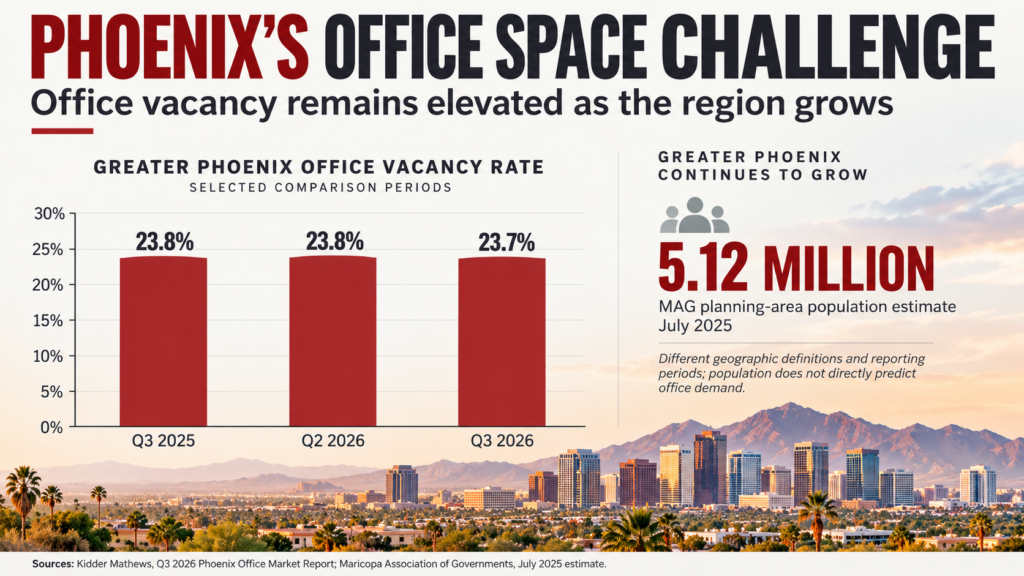
According to Kidder Mathews’ third-quarter 2026 Phoenix Office Market Report, the metropolitan area’s office vacancy rate stood at 23.7%, virtually unchanged from the previous quarter.
With approximately 95.3 million square feet of office inventory, that represents roughly 22.6 millio
n square feet of office inventory, that represents roughly 22.6 million square feet of vacant office space.
For commercial property owners, investors, and developers, those numbers raise an important question:
In a growing metropolitan area, what will it take to attract tenants to existing office buildings?
Increasingly, the answer may involve renovation, modernization, and finding new uses for older commercial properties.
Phoenix Is Still Growing. So Why Are Offices Empty?
Greater Phoenix remains one of the Southwest’s major population and employment centers.
The Maricopa Association of Governments estimated that its regional planning area, covering much of Maricopa County and portions of Pinal County, had approximately 5.12 million residents in July 2025.
Long-range regional projections anticipate continued population and employment growth, although the pace and geographic distribution will vary.
That growth creates demand for housing, healthcare facilities, professional services, retail businesses, and commercial infrastructure.
However, population growth and office occupancy don’t necessarily move together.
The workplace has changed significantly since 2020.
Hybrid schedules allow some businesses to operate with smaller offices. Other companies are consolidating multiple locations or relocating to buildings offering better amenities, more flexible layouts, and modern infrastructure.
Consequently, a growing business community doesn’t necessarily mean every existing office building will find a tenant.
In fact, some older properties may face increasing competition from newer or recently renovated buildings.
For landlords, simply having available square footage may no longer be enough.
Phoenix’s Office Vacancy Problem: Can Renovations Help Attract Tenants?
The Phoenix Office Market Is Showing Signs of Recovery
Despite elevated vacancy, recent commercial real estate reports suggest that the market is gradually stabilizing.
Kidder Mathews reported approximately 1.3 million square feet of leasing activity during the third quarter of 2026.
The market also recorded modest positive direct net absorption, meaning occupied office space increased slightly during the quarter.
Meanwhile, CBRE reported that the region continued removing obsolete office properties through demolition and conversion to alternative uses.
These developments suggest that Phoenix’s office market is adjusting rather than simply expanding.
Instead of constructing large quantities of new office space, investors and property owners are increasingly evaluating the potential of existing buildings.
That shift creates opportunities for commercial renovation contractors, particularly those experienced in tenant improvements, interior reconstruction, and property modernization.
What Do Today’s Commercial Tenants Want?
For many businesses, choosing an office involves more than location and monthly rent.
Companies must consider how their physical workspace supports employees, customers, and daily operations.
An outdated office with inefficient lighting, aging mechanical systems, and inflexible interior layouts may struggle to compete with a recently modernized property.
Several improvements can make existing commercial spaces more attractive to prospective tenants.
1. Flexible Office Layouts
Traditional offices often featured extensive private offices, narrow corridors, and large areas dedicated to individual workstations.
Today’s tenants may prefer a combination of collaborative spaces, private meeting rooms, flexible workstations, and multipurpose areas.
Commercial renovations can involve removing or relocating nonstructural partitions, updating electrical systems, and redesigning interiors to accommodate changing workplace requirements.
The objective is to create spaces that businesses can adapt as their needs evolve.
2. Modern Lighting and Energy Efficiency
Arizona’s climate makes building operating costs particularly important.
Commercial tenants may consider cooling expenses, insulation, lighting efficiency, and HVAC performance when evaluating potential locations.
Depending on the property’s condition, improvements could include LED lighting, updated controls, better insulation, energy-efficient windows, and mechanical-system upgrades.
These investments may improve comfort and reduce operating expenses, although actual savings depend on the building and the scope of work.
For property owners, energy efficiency can also become a competitive feature when marketing available space.
3. Updated Common Areas and Entrances
First impressions matter in commercial real estate.
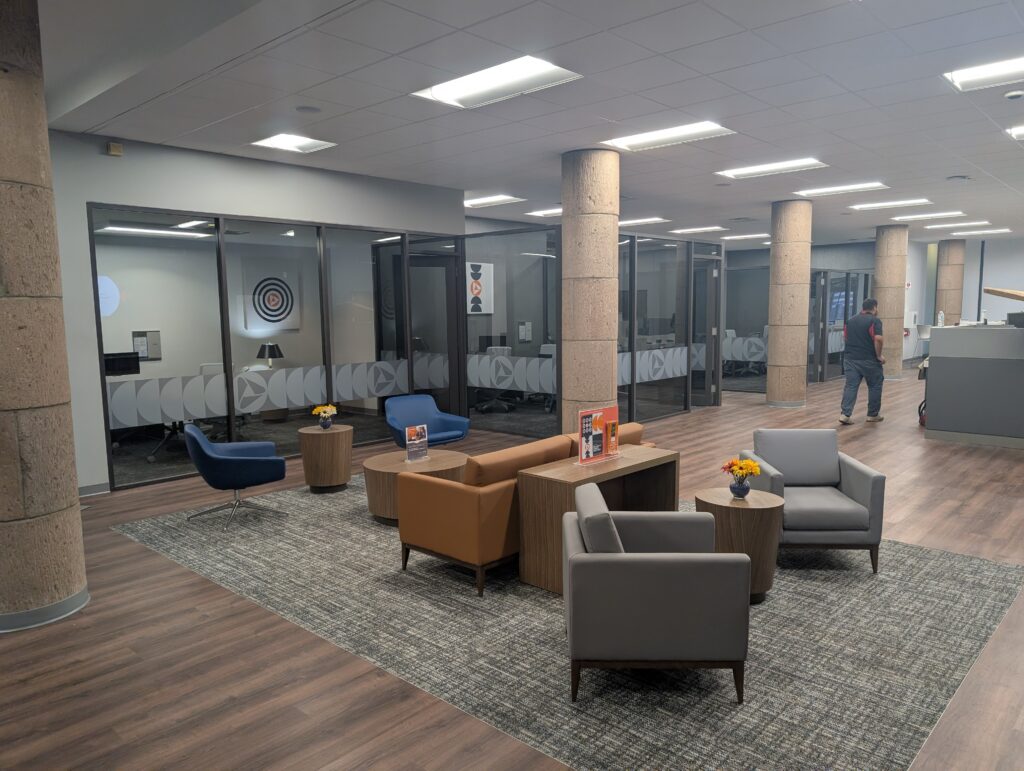
A dated lobby, deteriorating flooring, aging restrooms, or poorly maintained entrance can influence how prospective tenants perceive an entire building.
Renovating shared spaces may help reposition an older property without requiring a complete reconstruction.
Potential improvements include updated finishes, improved lighting, accessible entrances, modern restrooms, and refreshed reception areas.
These changes can be especially valuable for buildings competing for professional-services, healthcare, and customer-facing tenants.
4. Technology-Ready Infrastructure
Modern businesses depend on reliable connectivity and electrical infrastructure.
Older commercial buildings may require improvements to accommodate additional data cabling, networking equipment, conference-room technology, or changing electrical loads.
Planning these improvements during renovation can help avoid disruptive construction after tenants occupy the space.
5. Tenant-Specific Improvements
Not every business needs the same workspace.
A medical office has different requirements from an accounting firm, engineering company, or professional-services organization.
Tenant improvements allow commercial interiors to be adapted to specific operational needs.
Depending on the project, that might include new partitions, specialized rooms, plumbing modifications, electrical improvements, or accessibility upgrades.
For landlords, the ability to accommodate a prospective tenant’s requirements can be an important part of lease negotiations.
Could Population Growth Create New Opportunities for Existing Buildings?
Phoenix’s projected growth introduces another important consideration.
As the region adds residents, demand may increase for healthcare providers, financial services, educational facilities, professional offices, and other businesses serving expanding communities.
However, that demand may not emerge evenly across the Valley.
Some neighborhoods and employment corridors may attract more investment than others.
Property owners should consider population trends, nearby residential development, transportation access, employment patterns, and the types of businesses expanding within their submarkets.
For example, an older office property located near a growing residential community might be evaluated for medical, professional-services, or other neighborhood-serving uses.
A building near a major employment center might benefit from a different strategy.
The key is understanding which tenants are likely to need space in a particular location—and what improvements would make that property suitable for them.
Population growth creates possibilities, but successful redevelopment requires careful market analysis.
Renovation Versus New Construction: Which Makes More Sense?
For commercial property investors, deciding whether to renovate an existing building or pursue new construction requires a detailed evaluation.
Renovating may offer advantages when the building has a sound structure, desirable location, and infrastructure that can be adapted economically.
Potential benefits include retaining an established address, reusing existing structural components, and avoiding some costs associated with developing an entirely new property.
However, older buildings can present challenges.
Outdated mechanical systems, accessibility deficiencies, structural limitations, environmental concerns, and changes in occupancy classification can significantly affect renovation budgets.
In some cases, extensive reconstruction or redevelopment may be more practical than renovation.
A commercial contractor can help evaluate construction feasibility, identify potential complications, and develop preliminary budgets before an owner commits to a particular strategy.
What About Converting Office Buildings to Other Uses?
Not every vacant office building needs to remain an office.
Some property owners are exploring adaptive reuse, which involves converting existing buildings to serve different purposes.
Depending on zoning, building configuration, and financial feasibility, potential uses might include medical facilities, educational spaces, specialized commercial operations, or mixed-use developments.
Phoenix has an established Adaptive Reuse Program intended to assist qualifying projects involving older commercial buildings.
However, changing a building’s use can introduce additional requirements involving fire protection, accessibility, plumbing, parking, mechanical systems, and building codes.
Property owners should investigate these requirements early, ideally before purchasing a building or finalizing redevelopment plans.
Can Commercial Renovations Improve a Property’s Return on Investment?
Renovation can be an important tool for improving a commercial property’s competitiveness, but not every improvement produces an adequate financial return.
Before beginning construction, property owners should consider several questions:
- What types of tenants are actively leasing space in the surrounding market?
- Which building deficiencies are discouraging prospective tenants?
- What improvements are necessary for code compliance or occupancy?
- Could renovations support higher rents, shorter vacancy periods, or longer lease terms?
- How much revenue might be lost while construction is underway?
- Would a phased renovation allow portions of the property to remain occupied?
A targeted renovation strategy may offer better value than a complete cosmetic overhaul.
For example, upgrading an outdated lobby may improve a property’s presentation, but addressing inadequate electrical infrastructure or inefficient interior layouts could be more important to prospective tenants.
The right improvements depend on the building, its location, and the intended occupants.
The Future of Phoenix Commercial Real Estate May Depend on Adaptability
Phoenix’s population growth and elevated office vacancy are not necessarily contradictory.
They reflect a metropolitan area undergoing significant economic and workplace changes.
The region continues to grow, but businesses are reconsidering how much space they need, where they want to operate, and what features they expect from commercial properties.
For owners of aging office buildings, that creates both challenges and opportunities.
Some properties may benefit from relatively modest modernization. Others may require substantial tenant improvements, complete renovations, or conversion to entirely different uses.
The common factor is adaptability.
As Phoenix evolves, commercial properties that can evolve with it may be better positioned to compete for future tenants.
Planning a Commercial Renovation in Phoenix?
AZ Construction & Renovation provides commercial renovation, tenant improvement, project management, and ground-up construction services throughout the Phoenix metropolitan area and Southern Arizona.
Whether you’re evaluating improvements to an existing office building, preparing space for a new tenant, or considering a larger commercial construction project, our team can help you explore your options.
Contact AZ Construction & Renovation to discuss your commercial construction project.
Frequently Asked Questions
What is the office vacancy rate in Phoenix in 2026?
According to Kidder Mathews, Greater Phoenix’s total office vacancy rate was 23.7% in the third quarter of 2026.
Can renovating an office building help attract tenants?
Renovations may improve a property’s competitiveness by modernizing interiors, upgrading infrastructure, improving accessibility, and creating layouts suited to current tenant requirements. Results depend on market conditions, location, costs, and tenant demand.
What are commercial tenant improvements?
Tenant improvements are modifications made to commercial space to accommodate a tenant’s operational needs. They may include interior partitions, electrical upgrades, plumbing, flooring, lighting, and other construction work.
Is Phoenix’s population expected to keep growing?
Regional planning agencies anticipate continued long-term population growth in Greater Phoenix, although projections depend on economic conditions, migration patterns, housing availability, and other factors.
Should commercial property owners renovate or rebuild?
The decision depends on the existing building’s condition, intended use, renovation costs, zoning, code requirements, and anticipated financial return. A feasibility assessment can help owners compare their options.