
What the Fed’s Latest Rate Hike Could Mean for Construction and Renovation
If you have been considering building a home, renovating your current one or starting a commercial construction project, the Federal Reserve just gave you another economic development to watch.
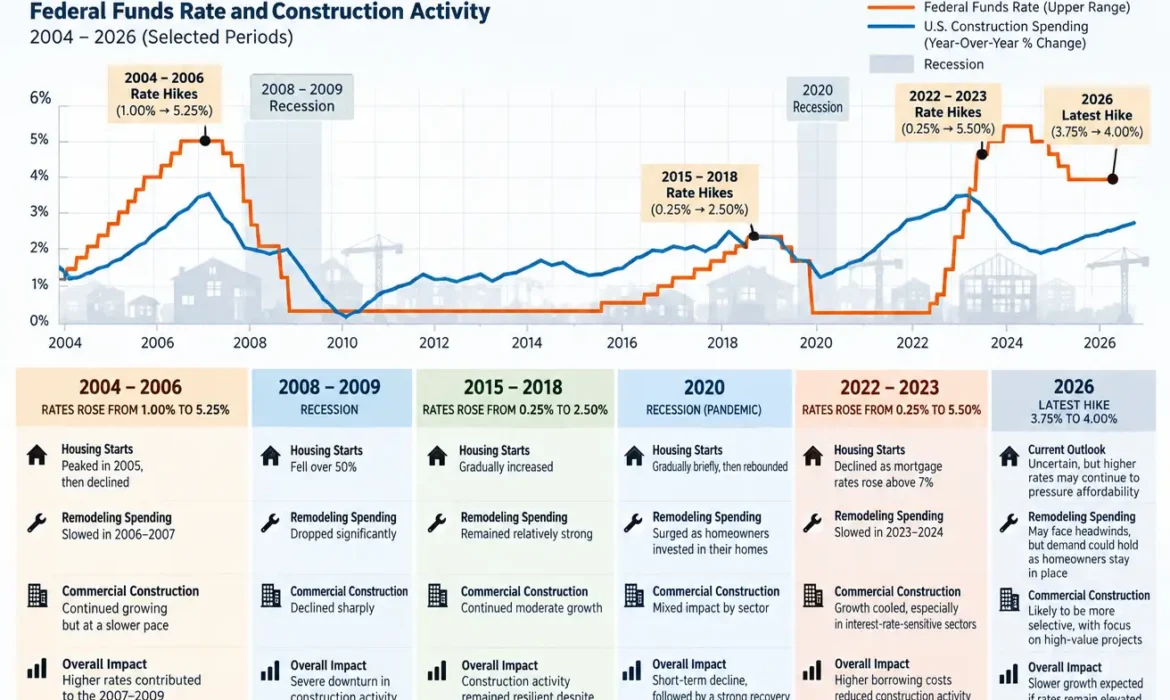
On September 16, the Federal Reserve raised its benchmark federal funds rate by a quarter percentage point, bringing the target range to 3.75%–4.00%. The move was intended to address inflation that remains above the Fed’s long-term 2% goal.
So, what does an interest rate hike in Washington have to do with a kitchen renovation in Phoenix, a commercial build-out in Scottsdale or a new home in Tucson?
Potentially quite a bit.
Higher Interest Rates Can Make Construction Financing More Expensive
The federal funds rate is not the interest rate consumers pay on a mortgage, home equity line or construction loan. However, changes in monetary policy can influence borrowing costs throughout the economy.
That matters because construction and renovation projects are frequently financed.
Homeowners may use home equity loans, HELOCs or other financing for major renovations. Developers and commercial property owners often depend on financing for acquisitions, construction and improvements.
When borrowing becomes more expensive, some projects that made financial sense at a lower rate may suddenly require another look.
A homeowner might reduce the scope of a renovation. A developer might postpone a project. A commercial property owner might divide improvements into phases rather than completing everything at once.
That doesn’t necessarily mean projects disappear. It can mean that planning, budgeting and prioritization become more important.

Mortgage Rates Can Affect New Construction
The effect can be particularly noticeable in residential construction.
Mortgage rates aren’t set directly by the Federal Reserve and can move differently from the federal funds rate. But higher borrowing costs can reduce affordability and weaken demand for new homes.
We have seen this before.
During the Fed’s previous tightening cycle, the National Association of Home Builders reported a steep decline in housing production after mortgage rates began rising rapidly in 2022. By September 2023, NAHB reported that mortgage rates above 7%, combined with high home prices, were slowing housing production.
The lesson isn’t that every Fed rate increase automatically produces a construction downturn. Far from it.
It does show how sustained higher borrowing costs can eventually influence what gets built, when it gets built and how projects are financed.
Could Higher Rates Actually Encourage Some Renovations?
Here’s the interesting part.
A difficult home-buying market doesn’t necessarily mean homeowners stop spending money on their houses.
Sometimes it changes where they spend it.
A homeowner with an attractive existing mortgage may be reluctant to sell that home, purchase another property at a higher price and take on a new mortgage at today’s rates.
Renovating the house they already own can become an alternative.
That could mean remodeling a kitchen, adding a bedroom, creating a multigenerational living space, building a casita or ADU, converting unused space or making an older home suitable for aging in place.
The last major rate cycle illustrates some of that resilience. In early 2023, NAHB expected residential remodeling to perform better than the single-family and multifamily construction markets during the housing downturn, although remodeling growth was expected to slow.
Eventually, higher prices, elevated interest rates and weak home sales caught up with remodeling as well. Harvard University’s Joint Center for Housing Studies later projected homeowner improvement and repair spending would decline during 2024, describing those three factors as significant headwinds for the industry.
In other words, remodeling isn’t immune to high interest rates—but it doesn’t necessarily respond exactly like new-home construction either.

Commercial Construction Faces Its Own Equation
For commercial property owners and developers, interest rates can affect more than the cost of the construction itself.
Financing costs influence the overall return expected from an investment.
That can make budgeting particularly important for tenant improvements, office renovations, retail spaces, restaurants and ground-up commercial projects.
Owners may look more carefully at improvements that can reduce operating expenses, improve energy efficiency, attract tenants or extend the useful life of an existing property.
Projects may also be completed in phases as businesses manage capital more cautiously.
What Happens Next?
One rate increase doesn’t determine the future of the construction industry.
Today’s environment includes many moving pieces: inflation, energy prices, labor availability, material costs, housing inventory and consumer confidence.
In fact, the Federal Reserve said economic activity remains solid even as inflation remains elevated. Its September projections also indicate that policymakers currently expect another rate increase during 2026.
For homeowners and businesses considering construction, the takeaway isn’t necessarily “build now” or “wait.”
It’s simpler than that.
Know your numbers.
Understand how the project will be financed. Establish a realistic budget. Decide which improvements are essential and which are optional. Allow room for unexpected costs, and work with a contractor who can help identify alternatives when the budget and wish list don’t perfectly align.
Interest rates may change.
A well-planned construction project should be prepared for that.